These resources are for reference and are not legal advice. Work with your solicitor and your county planning commission, which reviews municipal zoning amendments under the Municipalities Planning Code, before adopting any ordinance. Listing a resource here is not an endorsement.
Start Here
Pennsylvania Data Center Planning Toolkit
Pennsylvania Department of Community and Economic Development, 2026
The Commonwealth’s guide for local officials who receive a data center proposal, covering location drivers, infrastructure capacity, fiscal impacts, zoning, and legal considerations.
Check what your current zoning says. If data centers are not named, the use may be open to a validity challenge; if a proposal is already expected, ask your solicitor about a curative amendment resolution or a pending ordinance notice.
Decide where data centers belong: one industrial district, or a dedicated overlay district with a large minimum lot size.
Start from a model below, then compare it with the strongest adopted ordinances in the table further down.
Check the draft against the 52 criteria of the Tracker Standard, especially the Ten Core Protections: grid cost, water supply, cooling method, generator and air limits, noise, low-frequency noise, public transparency, farmland, home setback, and decommissioning bond.
Send the draft to the county planning commission for its required review, advertise it, and hold the public hearing.
Model Ordinances and Guides
Planning agencies, advocacy groups, and industry have each published models. Reading more than one shows where they agree and where they differ.
Planning Guide
Data Center Ordinance Guide, Version 1.0
Chester County and Montgomery County Planning Commissions, April 2026
A planning-agency guide with recommended ordinance language. Much of the template language in recently adopted southeastern Pennsylvania ordinances traces to it.
Sierra Club SEPAModel Ordinance 7.5 and Tiered Toolkit
Advocacy Model
Data Center Model Ordinance, Version 7.5, and Tiered Adoption Toolkit
Sierra Club Southeastern Pennsylvania Group (environmental advocacy), 2026
A full model ordinance plus three shorter versions to choose from. Track 1 is the minimum, Track 2 is the standard version the authors recommend when officials are unsure, and Track 3 is the most protective, for large campuses, sites near homes, or on-site power plants. A short Start Here guide helps officials pick a track, and a crosswalk for each track shows which parts of the full model it draws on. The models set specific limits for noise (40 dBA at night at homes in Track 2), generator testing, cooling, and effects on the power grid, and require a decommissioning bond.
The ten highest-rated adopted municipal ordinances in the tracker, rated against the 104-point Tracker Standard. Select a municipality to see its full entry and rating.
Counties can act in two ways: a county zoning or stand-alone ordinance, or data center standards in the county subdivision and land development ordinance, which apply wherever a municipality has no ordinance of its own.
Rated 40 of 104
Tioga County Ordinance No. 2026-3
Adopted February 10, 2026 · Rated 40 of 104
A stand-alone county data center ordinance applied by 24 municipalities, with a 1,000-foot setback from homes and required closed-loop cooling. The county also publishes a planning FAQ.
County subdivision and land development standards · Rated 45 of 104
Data center standards added to the county subdivision ordinance, which apply wherever a municipality has no subdivision ordinance of its own, including a 750-foot setback from homes and closed-loop cooling.
County Ordinances 1-2026 and 2-2026 · Rated 58 of 104
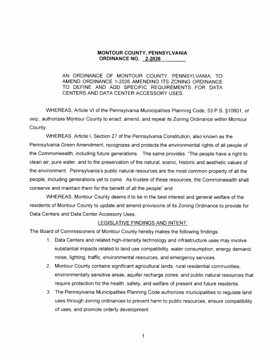
Montour County zoning applies in townships without their own zoning. Its 2026 amendments allow data centers only as a conditional use in the Industrial District, approved by the county Commissioners after a hearing.
Somerset CountyData Center Facilities Planning Ordinance
Rated 45 of 104
Somerset County Data Center Facilities Planning Ordinance
Adopted October 20, 2026 · Rated 45 of 104
A countywide ordinance that applies in every Somerset County municipality, with a 1,000-foot setback from homes, a 57 dBA noise limit, required closed-loop cooling, and quarterly reports on power and water use.
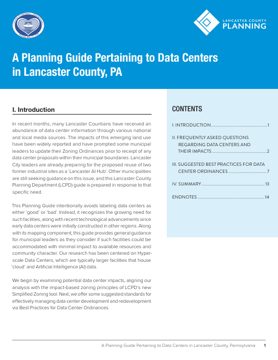
A Planning Guide Pertaining to Data Centers in Lancaster County
Lancaster County Planning Department, updated May 2026 (first edition November 2025)
Answers common questions about how data centers affect electricity rates, water, noise, air quality, traffic, jobs and taxes, and maps 60 industrial parcels near high-voltage lines. It also suggests ordinance standards for buffers, setbacks, noise in both dBA and dBC, water approvals, emergency plans, decommissioning and community benefits agreements.
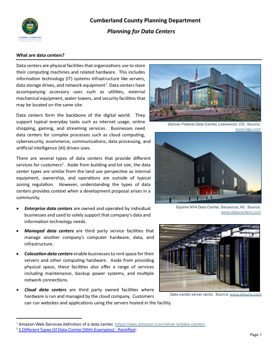
Cumberland County Planning Department, January 2025
A short white paper on the types of data centers, why they are drawn to the region, and the benefits and challenges they bring. It offers model definitions, recommended zoning districts, height and bulk standards, buffering, noise limits, and water and electric submission requirements.
A broad guide to managing warehouses, manufacturing and new industrial uses through comprehensive plans, zoning and subdivision rules. Its section on digital infrastructure (pages 24 to 28) lists the main impacts of data centers and recommends siting criteria, conditional use review and utility capacity requirements.
Pennsylvania Municipalities Planning Code (Act 247 of 1968)
Commonwealth of Pennsylvania
The law that governs local zoning. A zoning ordinance must allow every lawful use somewhere, so an ordinance that is silent on data centers can be challenged. A municipality that finds its own ordinance deficient may declare it invalid and enact a municipal curative amendment under Section 609.2, as several Pennsylvania municipalities did in 2026.
The order bars state environmental permits for data centers with peak demand above 25 megawatts until the project holds every local zoning and subdivision approval it needs and shows consistency with the local comprehensive plan. In August 2026, the Governor also ordered the state to prepare zoning best practices for municipalities.
Several Pennsylvania municipalities have passed resolutions that pause data center development while they write rules. These resolutions differ widely in legal strength. This is general information, not legal advice; a municipal solicitor should confirm the approach.
What a Moratorium Resolution Can and Cannot Do
Naylor v. Township of Hellam (Pennsylvania Supreme Court, 2001)
The Municipalities Planning Code gives municipalities no general power to suspend land development approvals while they revise their ordinances, and the Pennsylvania Supreme Court struck down a moratorium on that ground. A land development application is also reviewed under the ordinances in effect on the day it is filed. A stand-alone moratorium resolution therefore signals intent and may discourage an application, but it is unlikely to stop one that is filed, and it can draw a legal challenge.
The Lawful Pause: A Curative Amendment Resolution
Municipalities Planning Code, Section 609.2
A municipality with zoning may declare its own ordinance invalid for failing to address data centers. It then adopts a resolution with specific findings within 30 days and enacts a curative amendment within 180 days. During that period it need not consider a landowner's curative amendment or validity challenge on the same grounds. Hazle Township and Butler Township in Luzerne County used this procedure in 2026.
The declaration is a public admission that the ordinance is deficient, so a municipality that does not enact the amendment within 180 days may be more exposed than before. The procedure generally cannot be used again for 36 months. It corrects a zoning ordinance, so it offers little to a municipality that has no zoning. Richmond Township in Crawford County, which has no zoning, declared a moratorium under Section 609.2 in May 2026; its 180 days ended in November 2026 with no township ordinance found, and the county subdivision ordinance supplies the standards that apply there.
Zoning, but no data center rules: pass the Section 609.2 resolution and adopt the ordinance well inside 180 days. No zoning: adopt a stand-alone data center ordinance or subdivision standards, or rely on the county subdivision ordinance. Counties: amend the county subdivision ordinance, which covers every municipality without its own. A draft is nearly ready: advertise it, because a pending zoning ordinance can be applied to later zoning permit applications.
Bills in the Pennsylvania General Assembly that would change how data centers are regulated. The House bills listed have passed the House and are waiting in Senate committees, and Senate Bill 1345 is waiting in a Senate committee for a final Senate vote. The tracker lists them so readers can follow them; it takes no position on any bill.
House Bill 1834: Statewide Data Center Rules
Sponsor: Rep. Robert Matzie
Would set statewide rules for commercial data centers, including clean firm energy requirements (clean power that is available at all hours) and penalties for violations.
Passed the House · In the SenatePassed the House on March 24, 2026, by a vote of 104 to 95. In the Senate Consumer Protection and Professional Licensure Committee since March 31, 2026.
Would direct the Department of Community and Economic Development to write a model data center zoning ordinance that municipalities could choose to adopt. It would not require any municipality to use it.
Passed the House · In the SenatePassed the House on April 13, 2026, by a vote of 124 to 77. In the Senate Local Government Committee since April 23, 2026.
House Bill 2496: Local Pause on Data Center Applications
Sponsor: Rep. Paul Friel
Would let a municipality pause new data center land use applications for up to 180 days while it updates its zoning ordinance. A municipality could not use the same pause again for 18 months after it ends.
Passed the House · In the SenatePassed the House on June 24, 2026, by a vote of 201 to 1. The Senate Local Government Committee amended it on June 30, 2026, and it has been in the Senate Rules and Executive Nominations Committee since then.
Senate Bill 1345: Local Moratorium on High Impact Data Centers
Sponsor: Sen. Jarrett Coleman
Would give municipalities the option of a temporary moratorium on accepting or considering new applications for high impact data centers while they update their zoning. It is the Senate’s own version of a local pause.
In the SenateAmended on July 11, 2026, and given second consideration in the Senate on July 12, 2026. In the Senate Rules and Executive Nominations Committee since September 30, 2026; it has not had a final Senate vote.
House Bill 2650: GRID Certification for Data Centers
Sponsor: Rep. Joe Webster
Would amend the Tax Reform Code to change the computer data center equipment incentive program and create a Governor’s Responsible Infrastructure Development (GRID) certification with standards for data centers. News coverage describes it as writing the governor’s GRID framework into law.
Passed the House · In the SenatePassed the House on June 24, 2026, by a vote of 134 to 68. In the Senate Finance Committee since June 25, 2026.
Status checked November 2, 2026, on the General Assembly's website. The 2025 to 2026 session ends November 30, 2026. A bill that has not passed both the House and the Senate by then must be introduced again in the new session.
Statewide News
PA Environment Digest
PA Environment News LLC; David E. Hess, editor
A weekly online newsletter and daily blog on Pennsylvania environmental policy, edited by a former Secretary of the Pennsylvania Department of Environmental Protection. Its coverage includes data center legislation and state permitting.
No Conshy Data Centers (resident group, open data under CC BY 4.0)
A map of more than 130 data center proposals and related power plants, grid projects and pipelines across Pennsylvania, with project timelines, legal filings, state permit records and the organizations named in public records as backing each project.
Data Center Census tracks adopted rules in other states, Georgia Tech compares Georgia ordinances by theme, and the AI Now Institute offers a local policy toolkit.
These statewide agencies and organizations publish information on data centers, from different points of view. They are listed so that readers can learn more and find others working on these issues; the tracker does not endorse their positions. The model ordinances above from PennFuture, the Sierra Club and the Pennsylvania Chamber of Business and Industry also come from organizations active on data centers. Local resident groups are not listed.
Large Load Model Tariff
Pennsylvania Public Utility Commission
The state's utility regulator issued a final order on May 13, 2026 setting a model framework for how electric utilities serve data centers and other very large customers while protecting existing ratepayers.
Supporting Local Decision-Making for Data Center Development
Center for Rural Pennsylvania
A July 29, 2026 public hearing of the General Assembly's rural policy agency, with testimony from county and township officials, Penn State, the University of Pittsburgh and the Pennsylvania Farm Bureau.
Pennsylvania State Association of Township Supervisors (PSATS)
The statewide association of townships publishes news and holds webinars for township officials on data center issues, including state actions that affect local zoning.
A nonprofit that publishes guides, webinars and reports on how Pennsylvania's Environmental Rights Amendment (Article I, Section 27 of the state constitution) applies to data center permitting and zoning.
Pennsylvania shares one regional power grid, run by PJM Interconnection, with New Jersey, Delaware, Maryland, Ohio, and most of West Virginia, along with several other states. When data centers anywhere in PJM need more power, the cost of new transmission lines and of reserving enough power plant capacity can be shared by customers across the region, including Pennsylvania households. That means a data center across the state line can still affect Pennsylvania electric bills. New York runs its own separate grid, so data centers there do not share costs with Pennsylvania customers in the same way.
Rural electric cooperatives. Much of rural Pennsylvania is served by member-owned electric cooperatives rather than by investor-owned utilities. Their wholesale power comes through Allegheny Electric Cooperative, which also takes part in PJM, so regional grid costs reach co-op members too. Electric cooperatives are not regulated by the Public Utility Commission; each cooperative's rates are set by its elected board, so co-op members raise questions about large data center loads, and the rates and contracts for them, with their co-op's board and at its annual meeting.
A municipal ordinance can require a data center to pay for the grid upgrades it needs on site, but regional costs are set by PJM, the Public Utility Commission, and each cooperative's board, not by townships.
To see which Pennsylvania municipalities sit on the state line, and how their data center rules are rated, see Municipalities on the State Line.
PJM Interconnection
Regional grid operator
The organization that runs the regional grid and the wholesale power market, with planning documents and capacity auction results.
Resources were last checked on October 7, 2026, and the statewide organizations and regional power grid sources on October 23, 2026. To suggest a resource, use Submit a Correction.
Definitions of the zoning terms used on this site are on the Glossary page.
Beyond Your Municipality
Some decisions are made by the state or by regional agencies. You can comment on these too.
Your Municipality's Rules Now Matter More
Under Executive Order 2026-05, signed on August 18, 2026, the state will not issue environmental permits for data centers that need more than 25 megawatts until the project has every local zoning and subdivision approval it needs. Strong local rules come first.
A Local Pause Could Come from Harrisburg
Two bills in the General Assembly, House Bill 2496 and Senate Bill 1345, would let a municipality temporarily pause new data center applications while it updates its zoning. Neither has become law. You can follow them, and share your view with your state representative and senator, from Data Center Bills in Harrisburg.
Air Permits
Backup generators need a state air permit from the Department of Environmental Protection. Notices appear in the Pennsylvania Bulletin, followed by a 30-day comment period.
The Public Utility Commission decides who pays for new power lines and plants. Each power company must now file its own rates for very large users, and you can comment in those cases.
If your power comes from a cooperative: the Public Utility Commission does not regulate electric cooperatives. Your co-op's board, elected by its members, sets its rates. As a member, you can go to board and annual meetings, vote in board elections, and ask the board how it will charge large data centers. Find your cooperative.